HAPLAST Three Manufacturing Facilities: Delivering Comprehensive Packaging Solutions to Customers Worldwide
As global demand for high-quality and sustainable packaging continues to grow, manufacturers need more than production capacity—they need consistency, flexibility, and the ability to deliver at scale.
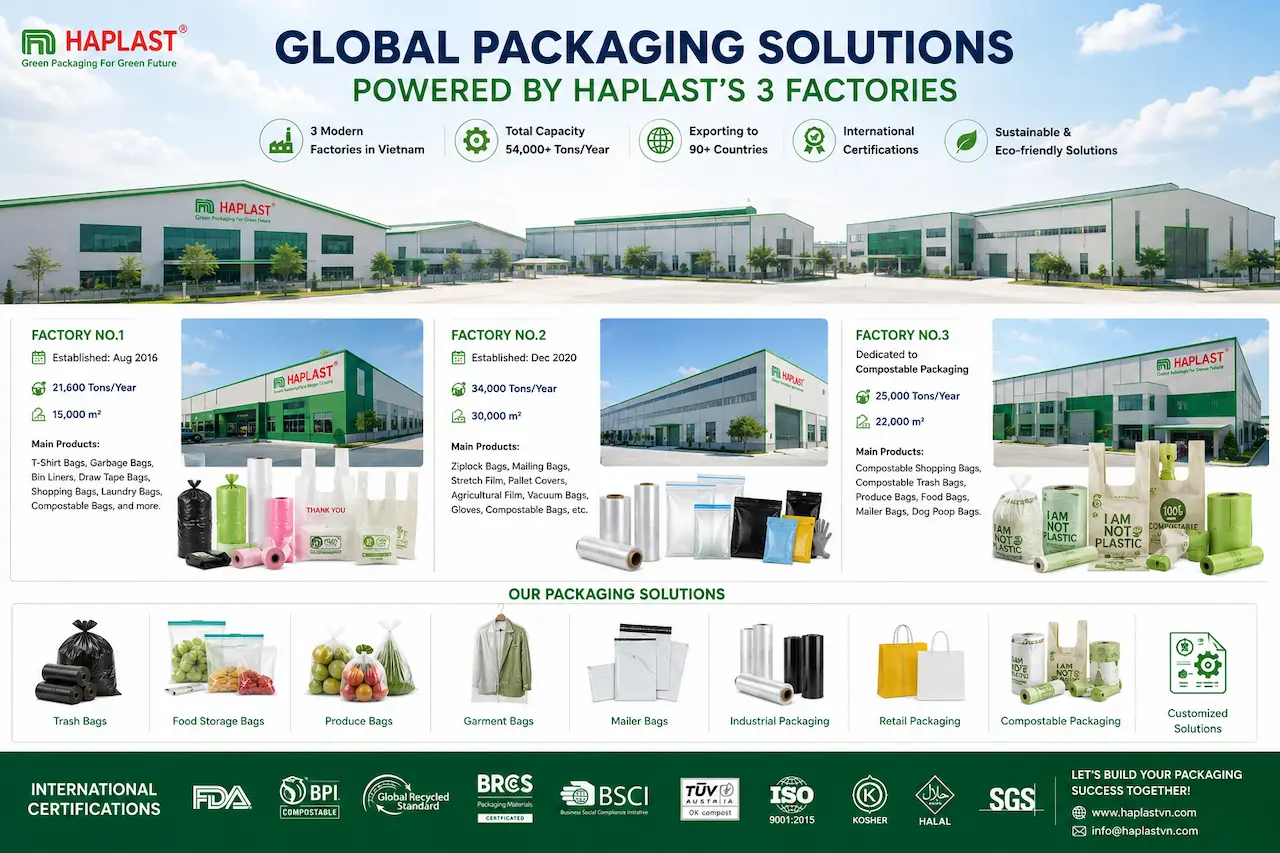
With nearly 20 years of manufacturing experience, HAPLAST has built a strong production network consisting of three modern factories in Vietnam. Together, these facilities enable the company to supply a diverse range of plastic and compostable packaging products to customers in more than 90 countries across North America, Europe, Asia, Australia, and other international markets.
A Manufacturing Network Designed for Global Supply
Each HAPLAST factory has been developed with a specific production focus while operating under the same strict quality management system. This integrated manufacturing model allows the company to efficiently handle both standard and customized packaging projects for retail, food service, industrial, logistics, and commercial applications.
By combining advanced machinery, experienced personnel, and streamlined production processes, HAPLAST delivers reliable products with consistent quality and competitive lead times.
Factory No.1 – Building the Foundation of Manufacturing Excellence
Commissioned in August 2016, Factory No.1 laid the groundwork for HAPLAST large-scale manufacturing operations.
The facility occupies 15,000 m², employs more than 300 skilled workers, and has an annual production capacity of 21,600 tons.
Its product portfolio includes:
- T-shirt bags
- Flat bags on roll
- Garbage bags on roll
- Bin liners
- Draw tape bags
- Luxury shopping bags
- Drawstring ice bags
- Laundry bags
- Block header bags
- Compostable bags
To ensure efficient and consistent production, Factory No.1 operates with:
- 45 extrusion lines
- 20 printing machines
- 88 cutting machines
- 30 auxiliary machines
Today, this factory remains one of HAPLAST key manufacturing centers, supplying household, retail, and commercial packaging to customers worldwide.
Factory No.2 – High-Volume Manufacturing for Diverse Industries
To support increasing international demand, HAPLAST expanded its production capacity by launching Factory No.2 in December 2020.
Covering 30,000 m², this facility has an impressive annual output of 34,000 tons, making it one of the company’s largest manufacturing sites.
Factory No.2 produces a wide variety of packaging products, including:
- Ziplock and slider bags
- Specimen bags
- Garbage bags
- Draw tape bags
- Stretch film
- Pallet covers
- Box liners
- Courier and mailing bags
- Garment bags
- Agricultural film
- Vacuum bags
- Bubble mailers
- Stand-up pouches
- Disposable gloves
- Compostable bags
Its production system includes:
- 82 extrusion lines
- 50 printing machines
- 120 cutting machines
- 70 auxiliary machines
The factory serves customers in retail, logistics, agriculture, food packaging, industrial manufacturing, and e-commerce, offering both large-volume production and flexible customization.
Factory No.3 – Advancing Sustainable Packaging Manufacturing
Recognizing the global transition toward environmentally responsible packaging, HAPLAST established Factory No.3 as a dedicated production center for compostable packaging solutions.
The factory covers 22,000 m² and has an annual production capacity of 25,000 tons.
Its main products include:
- Compostable shopping bags
- Compostable trash bags
- Produce bags
- Food bags
- Compostable mailer bags
- Compostable dog waste bags
- Compostable bags on roll
Using advanced manufacturing technologies and renewable raw materials, Factory No.3 produces certified compostable packaging designed to meet increasingly stringent environmental regulations and sustainability goals.
The facility enables HAPLAST to support businesses seeking environmentally friendly packaging alternatives without compromising product performance.
An Integrated Manufacturing Process
Across all three factories, HAPLAST follows a fully integrated production workflow to ensure product quality at every stage.
The manufacturing process includes:
- Raw material preparation and mixing
- Film extrusion
- Printing (when required)
- Cutting and sealing
- Packaging into cartons, bales, or pallets
- Warehouse storage
- Container loading for international shipment
This efficient production system helps maintain consistent quality while supporting fast delivery schedules for global customers.
A Complete Portfolio of Packaging Solutions
With the combined capabilities of its three manufacturing facilities, HAPLAST offers an extensive selection of packaging products, including:
- Trash bags
- Food storage bags
- Produce bags
- Garment bags
- Mailer bags
- Industrial packaging
- Retail packaging
- Compostable packaging
- Customized plastic packaging solutions
Whether customers require OEM, private label, or tailor-made packaging, HAPLAST provides flexible manufacturing solutions that meet diverse market requirements.
Certified Quality for International Markets
Quality assurance remains one of HAPLAST highest priorities.
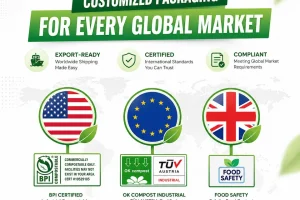
The company complies with internationally recognized standards and certifications, including:
- FDA Compliance
- BPI Certification
- Global Recycled Standard (GRS)
- BRCGS Packaging Materials
- BSCI
- TÜV Austria OK Compost
- ISO 9001:2015
- Kosher Certification
- Halal Certification
- SGS Testing and Factory Auditing
These certifications demonstrate HAPLAST commitment to product safety, sustainability, manufacturing excellence, and responsible business practices.
Your Trusted Global Packaging Manufacturing Partner
Supported by three advanced manufacturing facilities, experienced technical teams, modern production technology, and a comprehensive quality management system, HAPLAST continues to provide reliable packaging solutions for businesses around the world.
Whether you are sourcing retail bags, industrial packaging, food packaging, or certified compostable products, HAPLAST is ready to become your long-term manufacturing partner with customized solutions designed to meet your specific business needs.