Japan’s Sustainable Packaging Shift: Which Solution Delivers Greater Value?
How Is Sustainable Packaging Evolving in Japan?
In recent years, sustainability has become a top priority for businesses across Japan. From major retail chains and supermarkets to consumer brands and manufacturers, companies are increasingly seeking packaging solutions that reduce environmental impact while meeting customer expectations and regulatory requirements.
Among the most popular sustainable packaging options today are compostable packaging and recyclable packaging. While both contribute to environmental goals, they differ significantly in terms of infrastructure, cost, disposal methods, and practical applications.
So, which solution is better suited for the Japanese market?
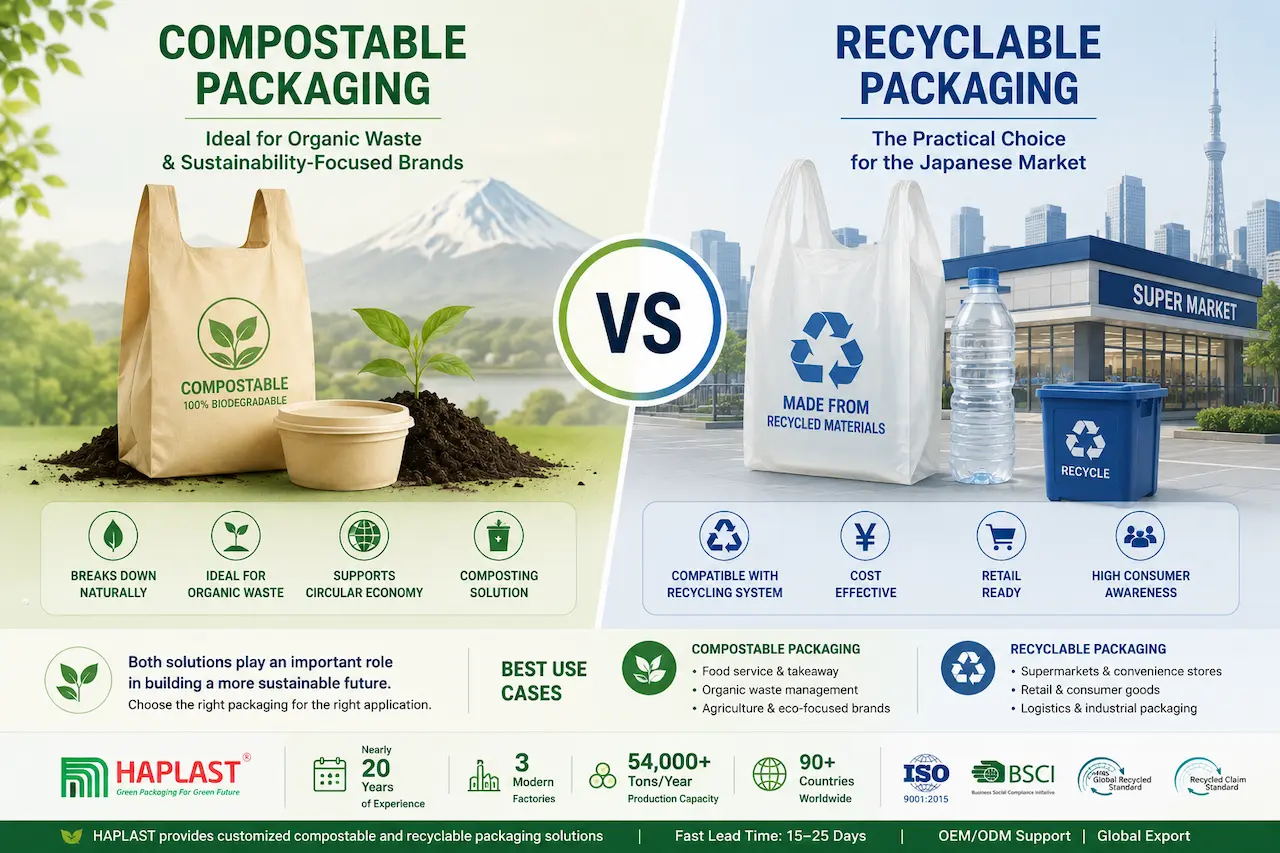
Compostable vs Recyclable Packaging: A Quick Comparison
| Criteria | Compostable Packaging | Recyclable Packaging |
| End-of-Life Solution | Breaks down into natural elements under composting conditions | Reprocessed into new raw materials |
| Infrastructure in Japan | Limited | Highly developed |
| Production Cost | Higher | More cost-effective |
| Consumer Familiarity | Growing | High |
| Suitability for Retail | Moderate | Excellent |
| Organic Waste Management | Excellent | Limited |
At present, recyclable packaging remains the most practical and widely adopted solution in Japan due to the country’s advanced recycling infrastructure and strong consumer participation in waste sorting programs.
Why Sustainable Packaging Matters in Japan
Japan is globally recognized for its efficient waste management systems and strong recycling culture. Following the nationwide implementation of plastic bag charging policies and the growing importance of ESG commitments, businesses are increasingly investing in environmentally responsible packaging solutions.
Today’s consumers expect brands to:
- Reduce plastic waste.
- Improve recyclability.
- Use environmentally responsible materials.
- Demonstrate genuine sustainability commitments.
As a result, packaging has become a key component of corporate sustainability strategies and brand reputation.
Compostable Packaging: Supporting a Circular Economy
Compostable packaging is designed to decompose into natural substances under specific composting conditions, leaving no harmful residues behind.
Key Benefits
- Supports circular economy initiatives.
- Helps reduce long-term plastic pollution.
- Enhances eco-friendly brand positioning.
- Suitable for organic waste collection systems.
Challenges
- Higher production costs.
- Limited composting infrastructure in Japan.
- Disposal methods may be unfamiliar to consumers.
- Not suitable for every packaging application.
Typical Applications
- Food service packaging.
- Organic waste collection bags.
- Agricultural packaging.
- Sustainability-focused premium brands.
While compostable packaging offers significant environmental advantages, its effectiveness largely depends on the availability of proper composting facilities.
Recyclable Packaging: The Practical Choice for Most Businesses
Recyclable packaging is made from materials that can be collected, processed, and reused as raw materials for new products.
Thanks to Japan’s well-established recycling systems, recyclable packaging has become one of the most practical and scalable sustainability solutions available today.
Key Benefits
- Compatible with existing recycling infrastructure.
- More affordable than compostable alternatives.
- Familiar to Japanese consumers.
- Easy to implement across large retail networks.
- Supports corporate ESG objectives.
Challenges
- Requires proper waste sorting.
- Recycling efficiency depends on collection systems.
- Some multi-layer packaging structures remain difficult to recycle.
Common Applications
- Supermarkets.
- Convenience stores.
- Retail chains.
- Consumer goods packaging.
- Industrial and logistics packaging.
For most retail and commercial applications, recyclable packaging provides the best balance between sustainability, affordability, and operational efficiency.
Which Solution Is Right for Your Business?
The ideal packaging solution depends on your industry, sustainability objectives, and operational requirements.
Recyclable Packaging Is Ideal For:
- Supermarkets and retail chains.
- FMCG and consumer goods brands.
- Businesses focused on cost efficiency.
- Large-scale distribution networks.
Compostable Packaging Is Ideal For:
- Businesses handling organic waste.
- Food service and hospitality sectors.
- Premium brands with strong sustainability positioning.
- Environmental innovation projects.
In practice, many Japanese businesses are achieving better results by strategically combining both solutions rather than relying exclusively on one material type.
The Future of Sustainable Packaging in Japan
Looking ahead, recyclable packaging is expected to remain the dominant solution across mainstream retail applications due to its cost advantages and mature infrastructure.
At the same time, compostable packaging is likely to gain momentum in niche sectors such as food waste management, agriculture, and environmentally focused premium brands.
Businesses that understand the strengths and limitations of both solutions will be better positioned to meet evolving regulations, consumer expectations, and long-term sustainability goals.
HAPLAST: Supporting Sustainable Packaging Solutions for the Japanese Market
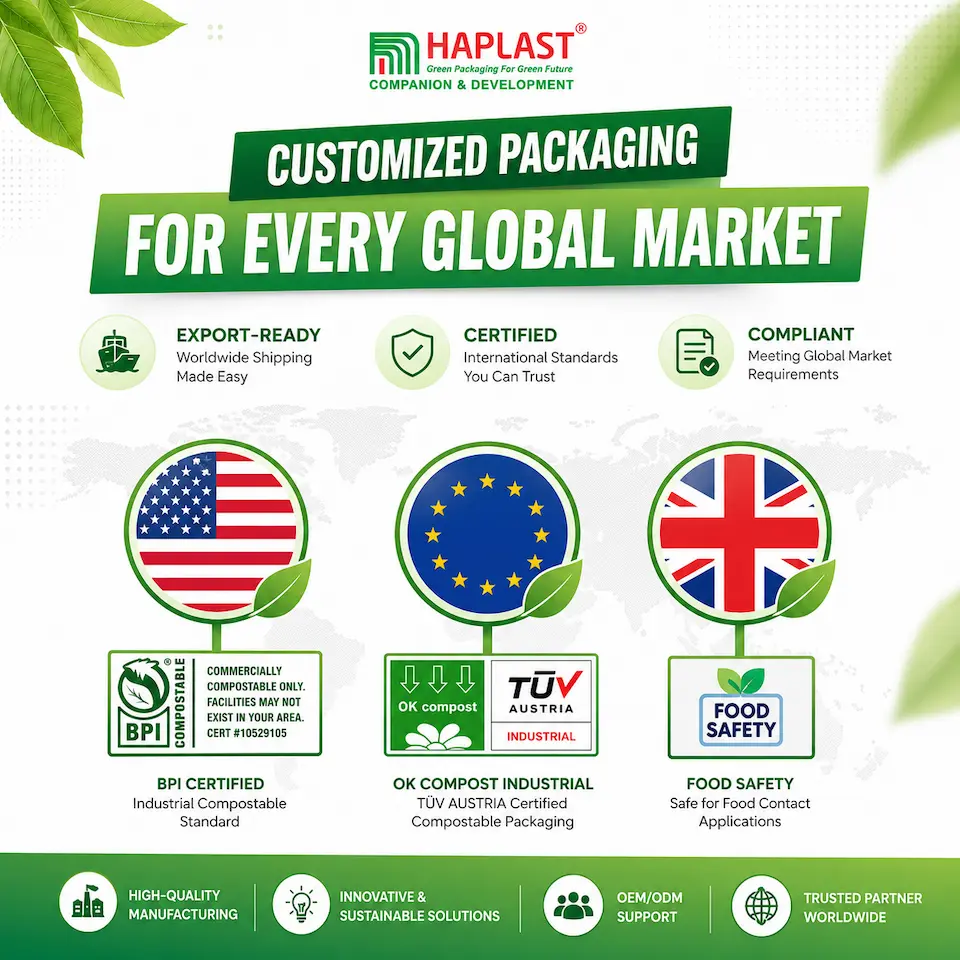
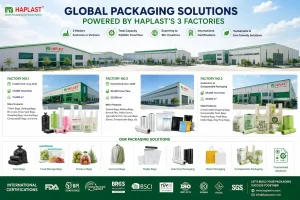
With nearly 20 years of manufacturing experience, three modern production facilities, and an annual capacity of approximately 54,000 tons, HAPLAST serves customers in more than 90 countries worldwide, including Japan, the United States, Europe, and Australia.
We provide:
- Recyclable packaging solutions.
- Compostable packaging solutions.
- Flexible OEM/ODM services.
- Advanced blown-film technology.
- International-standard quality management systems.
- Fast production lead times of 15–25 days.
- Comprehensive logistics and supply chain support.
Backed by internationally recognized certifications such as ISO 9001:2015, BSCI, GRS, and RCS, HAPLAST is committed to helping businesses achieve their sustainability goals while maintaining product performance and operational efficiency.
Sustainable packaging is no longer a trend—it is becoming the new industry standard. Choosing the right packaging solution today can create a lasting competitive advantage for businesses in Japan’s evolving market.