Thermoplastic Starch (TPS): A Green, Biodegradable Plastic Solution from HAPLAST, Vietnam
In the face of escalating pollution from petroleum-based plastics, there’s been a surge in interest in biodegradable materials capable of displacing these pervasive single-use synthetics. Thermoplastic starches (TPS), distinguished from thermoplastic styrene elastomers, emerge as a compelling solution in the pursuit of sustainable plastics. These materials are not only biodegradable but also derived from inexpensive and renewable resources, compatible with existing processing methods and machinery designed for synthetic plastics.
This discourse will delve into the fundamental aspects of thermoplastic starches, their intrinsic advantages and limitations, and the diverse array of TPS compositions and blends currently available.
The Essence of Starch
Starch is a naturally occurring resource primarily utilized by plants as an energy repository. Starch-rich crops, such as potatoes and rice, are staples globally and are instrumental across various industries, from food and flavorings to textiles and cosmetics. Its natural origin and abundance render starch fully biodegradable and renewable.
Chemically, starch is a polysaccharide comprising amylose and amylopectin. The extensive chains and branches of these biopolymers confer upon starch its unique physical attributes. The specific composition of starch is contingent upon the plant source, consequently influencing its properties.

Defining Thermoplastic Starch
While native starch has numerous applications, it requires processing to function as a plastic. When combined with water and plasticizers, such as glycerol and sorbitol, starch can be thermally processed and sheared to produce a biodegradable polymer known as thermoplastic starch (TPS).

TPS can undergo repeated cycles of heating, reforming, and cooling to fabricate various plastic products using existing synthetic plastic processing methodologies. Despite some limitations in its basic form, TPS is often blended with other polymers to create highly functional, cost-effective, and fully biodegradable plastics.
Starch composition varies with its botanical origin, adding complexity to TPS production but offering a wider spectrum of final plastic properties.
Advantages and Disadvantages of TPS
Thermoplastic starch holds promise as a viable substitute for many synthetic plastic applications. It is derived from natural and biodegradable sources that are abundant and inexpensive, making it an environmentally friendly and economically viable solution.
TPS is also highly adaptable. By blending it with other polymers, both natural and synthetic, its properties can be tailored for various applications. It can also be processed with existing plastic processing equipment, such as extrusion, injection molding, and blow molding.
In its unblended form, TPS has some drawbacks. It is prone to retrogradation, which leads to brittleness and compromised mechanical properties. It is also hydrophilic, resulting in high water solubility, poor water resistance, and diminished performance in humid environments.

Need a Thermoplastic Starch Solution Without the Drawbacks?
HAPLAST is Vietnam, the starch-based plastic, is a fully compostable and easy-to-recycle multilayer packaging solution. HAPLAST is Vietnam has excellent mechanical properties, resists embrittlement over time, and incorporates a PE/PET skin for water resistance.
Thermoplastic Starch Blends
To overcome the limitations of TPS, it is frequently combined with other polymers to enhance its properties. Blending strong but expensive polymers with abundant and sustainable TPS leads to cost-effective and biodegradable plastics.
- Starch x PVA: PVA is a high-cost, biodegradable polymer ideal for packaging. Blending it with TPS enhances mechanical and thermal properties while maintaining biodegradability and reducing cost. However, the blend remains hydrophilic, necessitating additives like glutaraldehyde for water barrier applications.

- Starch x PLA: PLA is a renewable polyester forming flexible films but is expensive and brittle. TPS/PLA blends aim to address TPS’s mechanical limitations while decreasing brittleness and cost. Co-plasticization and epoxidized vegetable oils are utilized to blend these inherently incompatible polymers. The resulting plastic has improved strength and remains biodegradable.
- Starch x PBS: PBS is a biodegradable polyester with good chemical and water resistance, thermal and mechanical properties, and processability. TPS/PBS blends offer improved tensile properties and water resistance at a reduced cost.

TPS Incorporated with Natural Fiber
Biopolymer composites such as TPS blends are often reinforced with fibers. Natural fibers, particularly from plants, offer advantages such as superior tensile properties, safety, biodegradability, and lower density, cost, and energy usage.
- Cellulose Fiber: Cellulose nanofibers enhance TPS’s tensile strength, lower density, improve water and thermal resistance. Both starch and cellulose are abundant and biodegradable.
- Sugarcane Fiber: Sugarcane fiber enhances TPS’s tensile strength and water resistance. However, the sugarcane’s quality affects the composite’s properties.
- Cassava Bagasse Fiber: Cassava fibers exhibit strong interactions with starches, enhancing tensile strength and water resistance.
Applications of Starch-Based Biopolymers
The renewability, biodegradability, and cost-effectiveness of TPS make it suitable for various applications, especially disposable plastic packaging.
TPS is increasingly employed in applications such as:
- Food packaging
- Disposable utensils
- Protective packaging and films
- Loose fill protective packaging
- Compostable films and bags

Biodegradable plastic bags
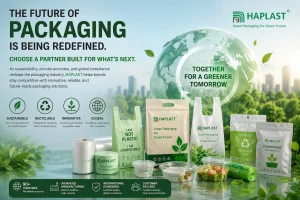
are an eco-friendly alternative to traditional plastic bags. Made from materials like cornstarch or PLA (polylactic acid), they are designed to break down naturally in the environment through the action of microorganisms, moisture, and sunlight. Unlike conventional plastics that may take hundreds of years to degrade, biodegradable bags can decompose within a few months under the right conditions. These bags are ideal for reducing plastic pollution, especially in landfills and oceans. They are commonly used in packaging, shopping, and food industries. While biodegradable bags help minimize environmental impact, proper disposal in composting facilities is crucial to ensure effective degradation. They represent a step forward in sustainable packaging and environmental responsibility.

HAPLAST: The Thermoplastic Starch-Based Plastic from Vietnam
HAPLAST is Vietnam’s thermoplastic, starch-based plastic for various packaging applications. Unlike conventional TPS, which is plasticized and blended, HAPLAST is derived from high-amylose corn starch through hydroxypropylation.
This process plasticizes the starch, yielding a thermoplastic with enhanced performance. HAPLAST does not undergo retrogradation, has excellent mechanical properties, is anti-static and oil-resistant, and is sealable, printable, and laser-etchable. HAPLAST also offers a superior gas and flavor barrier for food packaging.
HAPLAST is available in various modified starches for rigid packaging, injection molding resins, flexible films, and barrier resins.